Castin some Lightning spells
Oh you wanna be a w1z4rd? Alright, lets start at the bottom... well. The reasonable bottom. We are gonna learn about digital electronics today. Starting with transistors. While at this moment, it may seem useless I want you to keep in mind 2 things. Firstly, we are building from the basic building blocks, up to areas such as networking, operating systems and more. Its like a core pillar we can build a house around. The Second thing is that this will become useful once you start getting into hardware hacking. For example, if you ever feel the need to reverse engineer the Kiiroo sex toys, they use custom made ICs (more on ICs later).

So lets start off by talking about how electricity works a bit. The typical explanation is to think of water in pipes. We have 3 properties that make the water move: How much water is moving through the pipe (Charge), the Current which carries the water (Like the current of a river), and the force pushing or pulling the water through the pipe (Voltage). Looking down at the beautiful artwork I made, you can see the idea. The lines represent the pipes, and the box is a pump. The + pushes the water, and the - pulls it. With that image in your view, replace the water with electrons, moving away from the -, and towards the +. The "pump" can be imaged as just a AA Battery. Seems pretty chill, right? See, not too bad! Though I will give you a caveat, typically diagrams write circuits as the current moving from + to -. So if you see a circuit drawn where the Anode (Negative/"-") and Cathode (Positive/"+") seem swapped, they might be. Why? Well Electrons are always negatively charged, so when looking at the + and -, what we are looking at is the current FLOW. So which way the current is flowing. This is something that does trip a lot of people up, so I wanna explain it now. So now to make our little image correct, just swap the + and -.
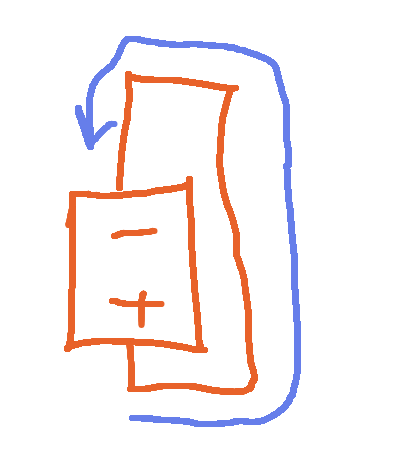
Another important aspect we need to think about is Resistence. Resistence is effectively, well resistence. In the water example, it could be a narrower portion of pipe, limiting how much current is flowing through the circuit. This is where the concept of Ohms law comes, in. Its a simple mathemtical thing that can help us understand how the current of a circuit is flowing. V = I * R. Voltage = Charge (I) * Resistence. The reason Voltage is the result, and not "Current" is because Voltage drives the Current. No voltage, no current, high voltage, high current. In the real world, this is significant. On a small hobbyist scale, small simple LED lights have low resistence, and if given 9V/Volts (Unit of Voltage), it will try and take all of it and burn out quickly. If our LED is rated for 20Amps (Amperage is the unit of measurement for Charge), and our battery is giving out 9V, we can use "I (Charge) = Voltage / Resistence".